
Introduction to Technology & AI
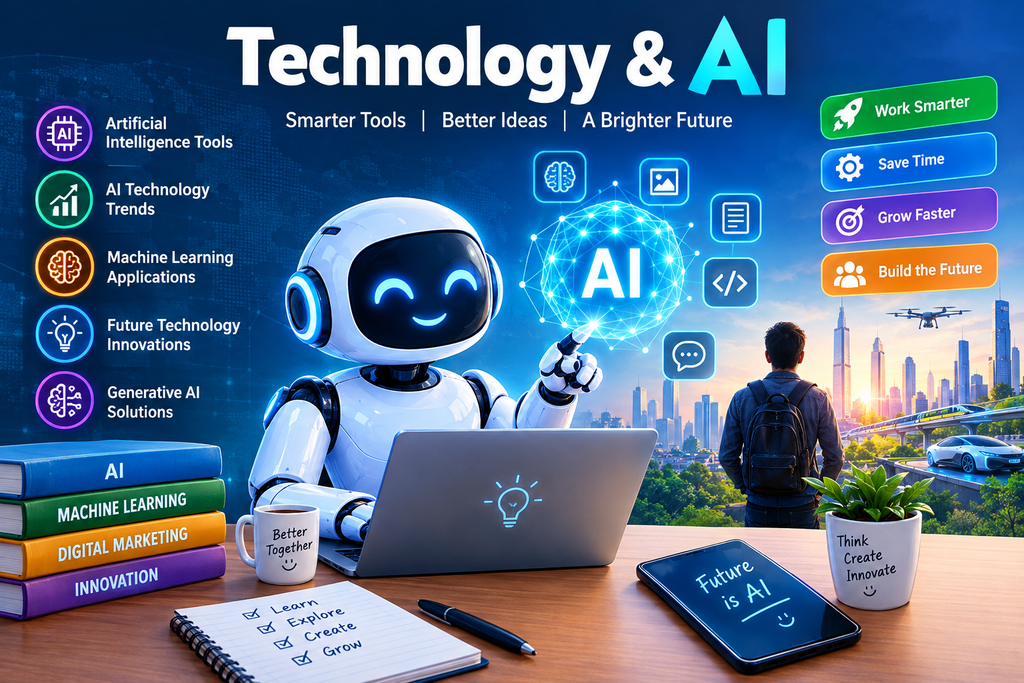
Technology & AI are transforming the way people work, communicate, learn, and do business. From smart assistants and automated customer support to advanced data analysis, artificial intelligence is becoming an essential part of modern life. Businesses, students, digital marketers, and content creators are using AI-powered solutions to improve productivity and simplify everyday tasks.
The rapid development of many Artificial Intelligence Tools, machine learning, and generative AI is creating new opportunities across multiple industries. Understanding the latest AI technology updates can help individuals and businesses make better decisions and prepare for the future.
In this guide, we will explore AI technology trends, machine learning applications, the best AI tools for beginners, and future technology innovations that are changing the digital world.
What Is Technology & AI?
Technology refers to the tools, systems, software, and innovations that help people solve problems and complete tasks more efficiently. Artificial Intelligence (AI) is a branch of computer science that enables machines to perform tasks that typically require human intelligence.
These tasks may include understanding language, recognizing images, identifying patterns, generating content, and making predictions.
For example, AI-powered chatbots can answer customer questions, recommendation systems can suggest products, and intelligent software can help marketers analyze customer behavior.
How Artificial Intelligence Works
Understanding how artificial intelligence works begins with three important concepts:
1. Data Collection: AI systems use relevant data to identify patterns and learn from examples.
2. Machine Learning: Machine learning algorithms help systems improve their performance by learning patterns from data.
3. Prediction and Generation: Depending on the system, AI can predict outcomes, classify information, answer questions, or generate text, images, audio, and other content.
Not every AI system works in the same way. Its capabilities depend on the technology, training data, model design, and task it is built to perform.
Best AI Tools for Beginners
The best AI tools for beginners make it easier to learn new skills, create content, organize information, and automate repetitive tasks. You do not always need programming knowledge to get started.
Here are some popular categories of AI tools to explore.
1. AI Writing and Research Tools
AI writing assistants can help users brainstorm ideas, create outlines, summarize information, and improve written content.
These tools can be useful for:
- Blog post planning
- Content rewriting and editing
- Research assistance
- Email drafting
- Social media captions
Always verify important facts and review AI-generated content before publishing it.
2. AI Tools for Digital Marketing
AI tools for digital marketing help marketers understand audiences, develop content ideas, analyze campaigns, and improve their workflows.
Common applications include:
- SEO keyword research and content planning
- Advertising copy generation
- Customer segmentation
- Social media content creation
- Marketing performance analysis
AI can support digital marketing decisions, but human expertise remains important for strategy, originality, brand voice, and quality control.
3. AI Image and Design Tools
AI-powered design tools can help users generate visual concepts, create illustrations, edit images, and develop marketing creatives.
They can be useful for bloggers, designers, entrepreneurs, and social media creators who want to explore new visual ideas.
Before using generated visuals commercially, check the tool’s licensing terms and applicable copyright requirements.
4. AI Productivity and Automation Tools
Productivity-focused AI tools can assist with meeting summaries, task organization, document analysis, and repetitive workflows.
For beginners, the best approach is to select one tool that solves a specific problem and learn its features before adding more tools to the workflow.
Latest AI Technology Updates and Trends
AI technology is evolving rapidly. Several important developments are influencing how individuals and organizations use digital tools.
1. Generative AI Solutions
Generative AI solutions can produce new content, including text, images, audio, video, and computer code.
Businesses use these systems for brainstorming, customer support, content development, and product prototyping.
However, generated results may contain errors, so fact-checking and human review are essential.
2. AI Agents and Workflow Automation
AI agents are designed to complete tasks through a sequence of actions, sometimes using external tools or software.
Depending on their capabilities and permissions, they may help with research, document processing, scheduling, or other structured workflows.
Organizations should consider security, accuracy, privacy, and human oversight before allowing AI systems to perform important actions.
3. Multimodal Artificial Intelligence
Multimodal AI can process or generate different types of information, such as text, images, audio, and video.
This technology can support applications such as visual question answering, voice-based assistance, document analysis, and interactive learning.
4. Responsible and Efficient AI
As AI adoption grows, organizations are paying greater attention to data privacy, reliability, transparency, energy efficiency, and responsible use.
These considerations are important when choosing AI systems for education, business, healthcare, and other sensitive applications.
Machine Learning Applications Across Industries
Machine learning applications are helping organizations analyze information, identify patterns, and make predictions.
Here are some examples of how this technology is used across different sectors.
Healthcare
Machine learning can assist with medical image analysis, research, patient-risk assessment, and administrative workflows. Medical decisions still require appropriate clinical expertise and validation.
Education
AI-powered learning platforms can help explain concepts, generate practice questions, and support personalized learning experiences.
Students should use these tools to improve understanding rather than rely on them without checking the accuracy of their answers.
Banking and Finance
Financial institutions use machine learning for fraud detection, transaction monitoring, risk assessment, and customer-service automation.
These applications require careful evaluation because errors can have significant consequences.
E-Commerce
Online stores can use machine learning to recommend products, forecast demand, analyze customer behavior, and improve inventory management.
Digital Marketing
Marketers can use AI to analyze campaign performance, identify audience patterns, generate content ideas, and assist with customer segmentation.
Combining AI insights with human judgment can help businesses make more informed marketing decisions.
Future Technology Innovations in AI
Future technology innovations may make AI systems more useful, accessible, and integrated into everyday activities.
Although the pace and impact of these developments remain uncertain, several areas are worth watching.
1. AI in Everyday Life
AI is already being used in navigation, voice assistants, smart devices, translation, and personalized recommendations.
In the future, these applications may become more integrated, helping people manage routine activities and access information more conveniently.
2. Robotics and Intelligent Machines
AI-powered robotics combines software intelligence with physical machines. Potential applications include manufacturing, logistics, agriculture, and assistance with repetitive tasks.
The effectiveness of these systems depends on their design, environment, cost, and safety requirements.
3. AI-Powered Business Operations
Businesses may increasingly use AI to support document processing, customer communication, forecasting, and internal knowledge management.
Successful adoption requires clear objectives, reliable data, staff training, and appropriate oversight.
4. Personalized Digital Experiences
AI can help digital platforms tailor recommendations, learning resources, and user experiences based on relevant information.
Businesses must balance personalization with transparency, consent, and respect for user privacy.
Benefits of Technology & AI
Technology & AI offer several potential benefits when used appropriately.
Improved Productivity: AI can help complete repetitive tasks and organize information.
Faster Research: AI tools can summarize documents and support early-stage research.
Content Assistance: AI can help generate ideas, outlines, drafts, and visual concepts.
Better Data Analysis: Machine learning can identify patterns that may be difficult to detect manually.
Learning Opportunities: AI assistants can explain concepts and provide practice activities.
Business Automation: Organizations can automate selected workflows and reduce manual effort.
These benefits are not automatic. Results depend on the quality of the tools, the tasks involved, and how effectively people review and use the output.
Challenges and Risks of Artificial Intelligence
Despite its advantages, artificial intelligence also presents important challenges.
Accuracy and Reliability
AI systems can generate incorrect information or produce convincing but misleading answers. Always verify important claims using trustworthy sources.
Data Privacy
Avoid entering confidential business information, passwords, financial details, or sensitive personal data into AI tools unless the service is appropriate and authorized for that use.
Bias and Fairness
AI systems can reproduce biases present in their training data or design. Testing and human oversight can help identify potential problems.
Copyright and Originality
AI-generated content may raise questions about ownership, originality, and permitted use. Review applicable laws and the terms of the tools you use.
Human Skills and Judgment
AI can support many tasks, but critical thinking, creativity, communication, and domain expertise remain valuable.
How to Start Learning AI as a Beginner
If you want to learn artificial intelligence, follow these practical steps.
Step 1: Understand the Basics
Learn what AI, machine learning, deep learning, and generative AI mean.
Step 2: Explore Beginner-Friendly Tools
Try AI assistants and productivity tools to understand their strengths and limitations.
Step 3: Practice With Real Tasks
Use AI to create a blog outline, summarize a document, organize a project, or brainstorm marketing ideas.
Step 4: Learn Prompt Writing
Practice giving clear instructions, relevant context, and specific output requirements.
Step 5: Verify the Results
Check facts, review generated content, and improve the output before using it.
Step 6: Build Small Projects
Create a simple chatbot concept, an AI-assisted content workflow, or a data-analysis project suited to your current skill level.
Consistent practice is more useful than trying to learn every AI tool at once.
Conclusion
Technology & AI are reshaping digital experiences, business operations, education, and creative work. From Artificial Intelligence Tools and generative AI solutions to machine learning applications, these technologies provide new ways to solve problems and improve productivity.
Understanding the latest AI technology updates can help beginners, professionals, and business owners identify useful opportunities while remaining aware of the limitations and risks.
The best way to get started is to choose a practical goal, explore suitable tools, verify the results, and keep learning as technology develops.
As AI continues to evolve, combining technological knowledge with creativity, critical thinking, and responsible decision-making will remain essential.
Frequently Asked Questions (FAQs)
1. What is Technology & AI?
Technology & AI refers to modern technologies and artificial intelligence systems that help people perform tasks, analyze information, automate workflows, and solve problems.
2. What are the best AI tools for beginners?
The best AI tools for beginners depend on their goals. Writing assistants, research tools, AI design platforms, and productivity applications are useful starting points.
3. How does artificial intelligence work?
Artificial intelligence uses different techniques, including machine learning and language processing, to analyze information, identify patterns, generate content, or perform specific tasks.
4. How are AI tools used in digital marketing?
AI tools for digital marketing can support keyword research, content planning, advertising copy, audience analysis, campaign reporting, and selected automation tasks.
5. What are the latest AI technology trends?
Important areas to watch include generative AI, AI agents, multimodal systems, workflow automation, and responsible AI development.
6. What is the future of AI in daily life?
AI may become more integrated into education, communication, navigation, smart devices, and personal productivity. The exact impact will depend on technological progress and responsible implementation.
7. Can beginners learn artificial intelligence without coding?
Yes. Beginners can explore many AI applications without coding. However, building AI models and developing advanced technical systems generally requires additional programming, mathematics, or data-science knowl
Best AI Tools for Beginners AI
Tools for Digital Marketing
Latest AI Technology
Trends Machine Learning Applications in Daily Life Future of Artificial Intelligence